Michele Vidarte
I
October 21, 2026
Crown Jewel: A Gilded Age Masterpiece Claims Its Place on the Manhattan Market
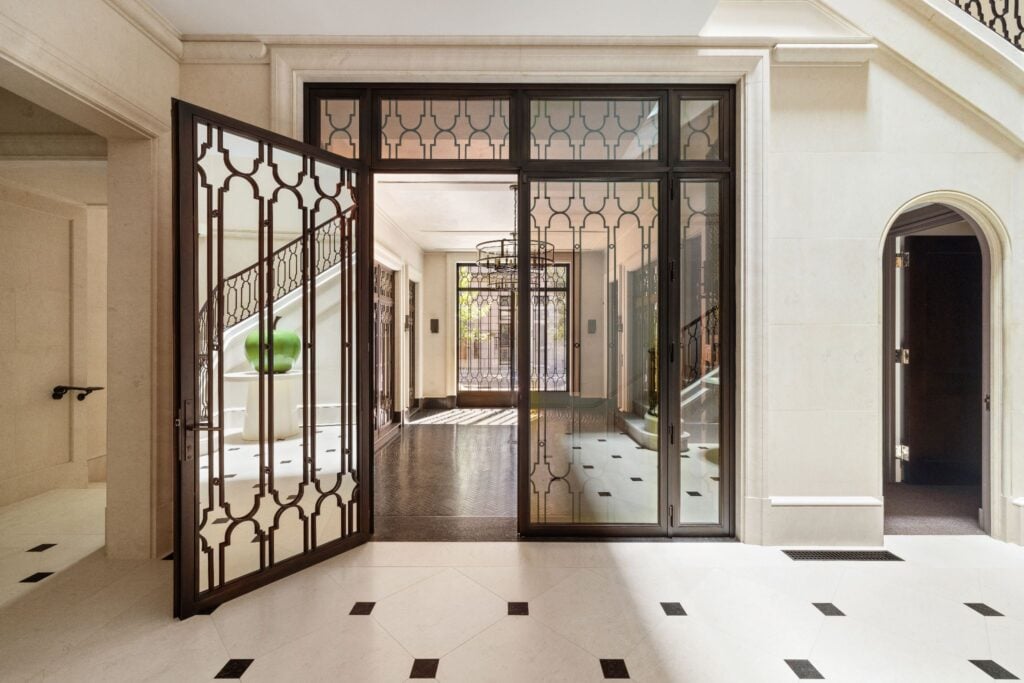
Since 1902, 165 East 70th Street has held court on New York City’s Upper East Side, when it was first constructed as a carriage house and stable by renowned architect, C.P.H. Gilbert, for banker Henri P. Wertheim. The limestone Neo-Italian Renaissance structure was built exceptionally wide (33 feet by 100 feet, to be exact), in order to provide everyday access to transport via horse and carriage. In 1920, the home was converted into chauffeur’s quarters for Stephen C. Clark, heir to the Singer Sewing Machine fortune, before being purchased by banking heir Paul Mellon and his wife, Bunny, in 1965. Sold in 2009, it was not until 2011 that the current owners began converting the structure into the expansive single-family residence that is now on the market, represented by The Agency New York’s Mike Fabbri. More than a century after its initial construction, the residence underwent a meticulous four-year transformation under architecture firm Sawyer | Berson, preserving the character of the original structure while completely reimagining its interiors for sophisticated modern living. Its six bedrooms, 13 bathrooms, six wood-burning fireplaces, and three private landscaped terraces were designed so that every floor feels connected and cohesive. “A lot of times, these grand homes can feel cold, but one of the most welcome features of this one is how warm it is and how much it feels like a place that deserves to be filled with people and memories and laughter,” said Fabbri, who specializes in Manhattan’s ultra-luxury real estate market. Sparing no detail with exceptional craftsmanship throughout, the home features quarter-sawn, hand-pillowed oak floors, Venetian plaster walls, custom silk carpeting and wallpaper, heated sidewalks, and a curb-cut driveway—a true Manhattan luxury. From the quiet, tree-lined street, mirrored Horus bronze doors open into a Petit Granit-floored private garage, which doubles as a chic entertaining space. Entering from the garage or the main entrance, a honed Beauvallon limestone-lined foyer surrounds a wrought iron and limestone staircase rising 46 feet toward the skylight above. This level also includes a custom mudroom, 13-seat soundproof theater fitted for full-scale screenings, and private guest quarters, including a full kitchen, living area, and primary ensuite. The second floor reveals a sequence of entertaining spaces: a living room with tempered glass windows overlooking 70th Street, a glass-enclosed dining room with custom Lockwood/Boone Collection pendants and hidden serveware storage, and an eat-in chef’s kitchen with a quartzite island, custom American White Oak-paneled Sub-Zero, Miele, and Wolf appliances, and a walk-out terrace. The third floor is anchored by an enigmatic, Sapele Mahogany-paneled library on one end and the primary suite, with dual dressing rooms and mirrored marble baths, on the other. Above on the fourth level, three additional ensuite bedrooms have hallway access to a 598-square-foot irrigated terrace. The fifth floor offers soundproof private offices, an expansive glass-paneled solarium, and direct access to the rooftop terrace. The home’s construction offers privacy and seclusion, with north, south, and east walls that are independent from neighboring structures. Below grade, a double-height cellar holds a Petit Granit-lined Jacuzzi/cold plunge, steam room, sauna, and massage room, plus a full gym walled and tiled in original two-inch virgin chestnut and mitered tile salvaged from the original horse ramps. A temperature-controlled 6,319-bottle wine cellar and a prep kitchen/laundry keep service separate from entertaining. Interiors are bathed in natural light with enviable access to more than 1,350 square feet of private outdoor space across multiple levels. From the heated kitchen terrace to the expansive fourth-floor walk-out terrace and the rooftop above, each of the outdoor spaces was designed as a natural extension of the interiors. The private 480-square-foot rooftop features custom landscaping by Verdant NY, wood decking, seating areas, faux turf, and a snowmelt system. Moments from Central Park and The Frick Collection, and across from the New York School of Interior Design, in School District 2 (PS 267; JHS 167 Robert F. Wagner), 165 East 70th Street is ready for a new chapter. To learn more about 165 East 70th Street or to schedule a showing, contact The Agency New York’s Mike Fabbri. The post Crown Jewel: A Gilded Age Masterpiece Claims Its Place on the Manhattan Market appeared first on The Agency Journal.